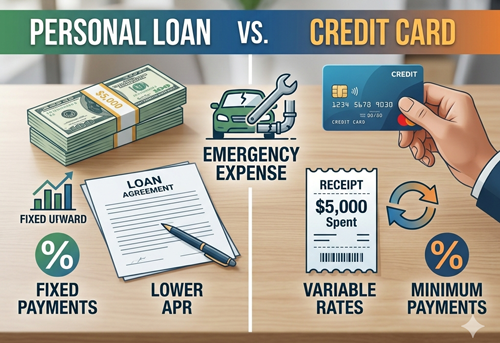
Which is Cheaper for a $5,000 Expense?
You have an unexpected expense, and your starter emergency fund is not quite full yet. Now you are facing a major financial decision: should you look for 5000 dollar loans, or should you just put the expense on your credit card?
Both options will get the bill paid, but choosing the wrong one could cost you hundreds—or even thousands—of dollars in extra interest. Let's break down the math and the realities of both options to find out which is truly cheaper.
The Basics: How They Work
Before diving into the numbers, it is crucial to understand how these two financial tools differ in structure.
Credit Cards (Revolving Debt): You are given a credit limit. You can spend up to that limit, pay it off, and spend it again. If you do not pay the full balance by the end of the month, you are charged interest on the remaining amount. The interest rates are typically variable and quite high.
Personal Loans (Installment Debt): You receive a single, lump-sum payment of $5,000. You then pay it back in fixed monthly installments over a set period (like 24 or 36 months). The interest rate is usually fixed for the life of the loan.
When a Credit Card is Cheaper
Believe it or not, a credit card can be the absolute cheapest way to borrow $5,000, but only under one very specific condition.
The 0% Intro APR Offer: If you have good to excellent credit, you might qualify for a new credit card that offers a 0% introductory APR for 12 to 21 months.
The Catch: You must pay off the entire $5,000 before the promotional period ends. If you miss a payment or leave a balance when the promo expires, a sky-high interest rate (often 20% to 29%) will kick in immediately.
If you do not have a 0% promo offer, standard credit cards are almost always the more expensive route.
When a Personal Loan is Cheaper
For the vast majority of people, 5000 dollar loans in the form of standard personal loans will be the cheaper, safer option.
Lower Average APRs: While standard credit cards often carry APRs over 22%, personal loans for borrowers with good credit typically range from 8% to 15%.
Forced Discipline: Because a personal loan has fixed monthly payments, you are forced to pay down the principal. Credit cards allow you to make "minimum payments," which barely cover the interest and keep you in debt for years.
Debt Consolidation: If you have already put $5,000 on a high-interest credit card, taking out a personal loan to pay off that card (consolidation) is one of the smartest financial moves you can make.
Cost Comparison: The Math on a $5,000 Expense
Let's look at the cold, hard numbers. Here is what happens if you borrow $5,000 and plan to pay it off over 24 months.
| Borrowing Method | Average APR | Monthly Payment | Total Interest Paid |
|---|---|---|---|
| 0% Promo Credit Card | 0% | $208.33 | $0 |
| Good Credit Personal Loan | 10% | $230.72 | $537.39 |
| Standard Credit Card | 24% | $264.35 | $1,344.48 |
| Bad Credit Installment Loan | 35% | $293.81 | $2,051.48 |
The Verdict: Unless you can secure and strictly manage a 0% introductory credit card, a personal loan will save you over $800 in interest compared to a standard credit card.
How Your Choice Impacts Your Credit Score
Your decision also impacts your credit profile.
Putting a $5,000 charge on a credit card with a $6,000 limit will spike your credit utilization ratio to over 80%. This will cause your credit score to drop significantly until the balance is paid down.
A personal loan, however, is classified as installment debt. It does not factor into your revolving credit utilization. In fact, making on-time payments on an installment loan can actually help diversify your credit mix and boost your credit score over time.
Conclusion
If you know you can pay off the expense in under a year and qualify for a 0% promo card, take advantage of the free money. However, if you need 2 to 5 years to comfortably pay back the debt, standard 5000 dollar loans are the clear winner. They offer lower interest rates, predictable monthly payments, and a clear finish line to becoming debt-free.